

The Billion-dollar company engcon switched to Monitor ERP in just four months
engcon Group is a global company with over four hundred employees in sixteen countries. When it was time to change ERP system, it was clear that the project required determination, clear priorities, and a strong focus on standardization. They chose Monitor ERP and in only four months engcon had successfully changed their entire ERP system which was a strategic move for continued international growth.
“Our goal is not to become the best at ERP systems. Our goal is to offer the best products. An ERP system should be a tool that helps us achieve this,” said Stig Engström, the founder and largest owner of engcon.
engcon was founded in 1990 in Strömsund and has grown from a small, entrepreneurial company to an international group of around fifteen sales companies and two manufacturing companies operating around the globe – from Japan and Korea to the USA and Canada. The group has a turnover of almost two billion Swedish kronor and four hundred employees. Their core product is the tilt rotator – a piece of equipment that enables the bucket of an excavator to rotate and tilt. An innovation that Stig had already realized the potential of in the eighties.
In our situation, a standardized system was the only option. We need to have the basic processes in place: purchase, stock, manufacturing, construction and delivery. The rest can be finessed at a later stage.
“It’s taken longer than you could believe, but it is a product for the world. And we still have a lot to do,” he said.
For many years, engcon has used a variety of different ERP systems, each with a multitude of customizations. As time went on, it became more and more difficult to develop the solutions any further.
“We had outgrown our old systems. With all of the customizations we would need to restart from the beginning with each major update. It simply wasn't sustainable,” added Stig.
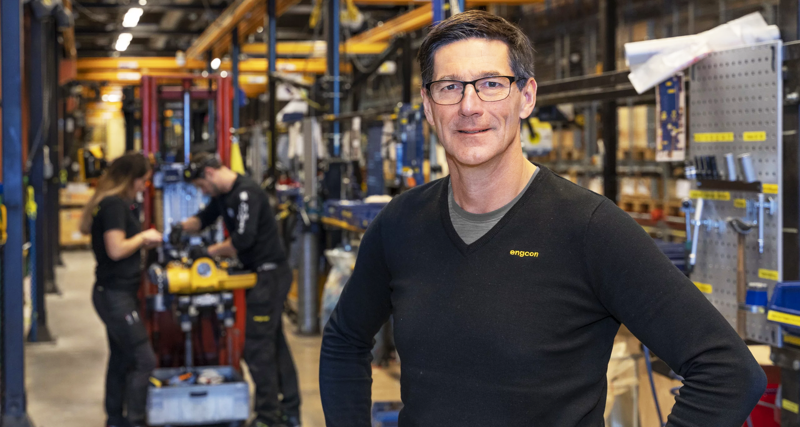
A previous attempt at implementing a more customized ERP system was a lesson.
“The system itself wasn’t the problem. The problem was that we were required to know exactly how it should be built and that is something we just don’t know how to do. It was far too complex,” he explained.
That’s why engcon chose a standardized system – Monitor ERP. A decisive factor was the ability to quickly have a complete solution up and running without the need for substantial customizations.
We had outgrown our old systems. With all of the customizations we would need to restart from the beginning with each major update. It simply wasn't sustainable.
“In our situation, a standardized system was the only option. We need to have the basic processes in place: purchase, stock, manufacturing, construction and delivery. The rest can be finessed at a later stage,” said Stig.
There were expectations to be met from the business side of things as well. Johan Johansson, Project Manager at engcon, recognizes the benefits of everyone working in the same system:
“The main objective is to have better control of manufacturing and purchase. A small but equally important bonus is that the whole group will work in the same system. Previously we all worked in different systems,” said Johan.
Twenty-one companies were involved in the project – manufacturing companies, sales companies, and finance companies – which all simultaneously went live with Monitor ERP on January 5, 2026. The project started in the middle of August 2025 and involved a short implementation time.
“The challenge was the amount of time and the scale. We have companies in different parts of the world, each with their own requirements, and we were going from several systems to just one,” explained Johan.
Monitor has a very clear project model. It’s evident that they have done this many times before which helps create a sense of security.
To be successful, a project group was assembled consisting of representatives from purchase, stock, manufacturing, sales, and finance. Parallel work was carried out in a number of directions with a large focus placed on data migration and shared ways of working.
“Monitor has a very clear project model. It’s evident that they have done this many times before which helps create a sense of security,” added Johan.
The project manager from Monitor ERP was Andreas Ljungqvist, a business consultant with many years of experience.
“engcon was abnormally prepared for the change. They have clear ownership of processes and a good understanding of how data and business processes coincide. It makes a huge difference,” he said.
One of the largest benefits of Monitor ERP for engcon is that they're able to create a unified way of working.
“Each sales company used to do its own thing. Now we all work in the same way. This is something that is much needed when it comes to transparency and follow-up. When there is an uplift in the market again, we need to be ready. This requires control over purchasing, deliveries, lead times, and stock. The ERP system is crucial for this,” said Stig.
January 5, 2026, marked the start of a new phase for engcon. There is still some way to go with improvements and development – but with a stable foundation to build on.
“The dream scenario is having a simple, transparent system where everyone can access the same information and can focus on the right things. The ERP system shouldn’t get in way. It should help us get better at what we do,” concluded Stig.

-

Customer cases
Qvantum saves time and improves invoice flow using EIM Workflow
Qvantum is a producer of heat pumps at the forefront of energy transformation that understands the broader societal perspective and the integration of heating systems into larger energy grids. By combining robust Swedish engineering with innovative software, Qvantum has developed an energy efficient
-

Customer cases
Gebwell Oy switched to Monitor ERP in record time
The ERP system was upgraded to support the company's growth, internationalisation and business process development. As Gebwell Oy's business has grown, it has been important to develop ways of working and ensure that the systems are able to support future needs. An important step in this development
-

Customer cases
Focus on efficiency and trust: Lind Jensen Maskinfabrik and three years with Monitor ERP
For more than 60 years, Lind Jensen Maskinfabrik has delivered quality solutions to a wide range of industries. The Hydraulics division supplies OEMs around the globe with mobile hydraulics, lift/crane equipment, and hydraulics for the wind industry. The Agri division provides several overseas marke
-

Customer cases
LEAX Skaraborg boosts efficiency with Advanced stock management
When LEAX Skaraborg chose to implement Advanced stock management, their daily workflow improved significantly. From manual and time-consuming to efficient and well-structured. “I’d recommend Advanced stock management to other companies. I don’t understand how we managed without it! Advanced stock ma
-

Customer cases
Bank integration helps ELMAB simplify their payment flows
For ELMAB, a leading Swedish manufacturer of hydraulic cylinders and components, Monitor ERP’s Bank integration has been a significant success factor. Bank integration optimizes the finance department’s day-to-day work by automating payment flows, reducing manual input, and minimizing the risk of er
-

Customer cases
From manual to automated – Eco Log optimizes their processes with PDM integration
For Eco Log, a leading manufacturer of forestry machinery, the pursuit of efficiency and high-quality data is what led them to implementing PDM integration. Thanks to PDM integration, Eco Log has successfully been able to automate the transfer of data between their product data management (PDM) and
-

Customer cases
Monitor ERP’s Agent option makes National’s administrative procedures more effective
For National, a company specialized in the manufacturing of high-quality rubber, plastic and fiber products, Monitor ERP’s option, the Agent, is the obvious choice. Administrative procedures have been automated, which has led to an increase in productivity. “As the Agent takes care of the daily and
-

Customer cases
Effective time recording – a necessity for Borins AB
For the Swedish company Borins AB, which is known for its broad range of high-quality products and services, Monitor’s TimeCard plays an essential role. By using TimeCard, Borins AB’s employees can easily record their working hours directly on specific work orders, which means that they no longer ne
-

Customer cases
From 70 million SEK to a quarter of a billion – with the same person single-handedly managing the financial administration
Financial administration often gets overlooked in manufacturing companies. It’s seen as tedious and dull – but with the right tools, it can become both efficient and inspiring. “We’ve gone from what feels like Stone Age methods to using the latest technology and the best support available,” says Mik
-

Customer cases
Furhoffs Rostfria delivers every time with the Product configurator
When you’ve got many different product variations and the customer needs can shift quickly, it can be a real challenge to manage orders and production. For Furhoffs Rostfria, one of Sweden’s top manufacturers of stainless-steel products such as sinks, washbasins, urinals, and floor drains, the solut
-

Customer cases
Monitor ERP Helps Bjerrum Nielsen Boost Productivity
Almost three years ago, the Danish production company Bjerrum Nielsen took a significant step by replacing their old ERP system, C5, with Monitor ERP. The implementation was managed by Monitor, and it has proven to be a good decision for the company, which now sees major improvements in their operat
-

Customer cases
BM Silo has gone live with Monitor ERP – strong collaboration creates strong results
November 3 marked an important milestone for BM Silo, which has now gone live with Monitor ERP. The process has been characterized by close collaboration, great commitment and a shared ambition to reach the goal of creating a more efficient and digital foundation for the future. A natural choice for